



Lynne Ramsay’s Die My Love—which is her first feature in 8 years– is a superbly directed movie, even if it falters quite a bit in the third act. It’s an unforgettable movie that pulls you in and stays with you well after the credits roll. It’s a movie that is unnerving, even uncomfortable, and it demands reflecting upon. The effect is visceral, shocking, saddening, and disorienting as Ramsay observes a woman experiencing a nervous breakdown from the anxieties of postpartum depression.
It’s a film that explores depression, and it’s no surprise that Ramsay taps into the psyche in ways that other arthouse films have tapped into psychoses, like Belle De Jour or Repulsion. There are some abstractions, and many elements feel heightened, but the material is very thoughtful. Yet I hesitate to call Die My Love an extraordinary piece of cinema the way I found previous Ramsay films like Morvern Callar, Ratcatcher, or You Were Never Really There, and while it hits a lot of familiar notes throughout with some characters lightly sketched, Ramsay deserves credit for how she continues to elevate the art form on a technical, visual, and even thematic level.

Courtesy of Mubi
It’s also relevant to point out there are similar roots in previous Ramsay films about women experiencing psychological breakdowns from relationships and the men in their lives with Morvern Callar and We Need to Talk About Kevin. This is, of course, a film that feels singular on its own, but Ramsay’s artful and visual lyricism continues to shine, and this is by far her most histrionic film she has made yet, as it certainly channels some shades of Tennessee William’s A Streetcar Named Desire and a more manic version of John Cassavetes—think A Woman Under the Influence, which is also about a housewife whose behaviors lead to severe conflict with her blue-collar husband. Like that film, it uses a character study approach, as we are with the character in every scene, and we feel the paranoia, insecurities, panic, and fear and other human feelings like loneliness, alienation, and disconnect as nothing makes sense. Ironically, the film in many ways also resembles Darren Aronofsky’s mother! which also stars Jennifer Lawrence as a housewife living in a country house. Although it isn’t a horror film or as focused on shock value as Aronofsky’s mother! was, Die My Love is still manic and just as frantic on different levels.
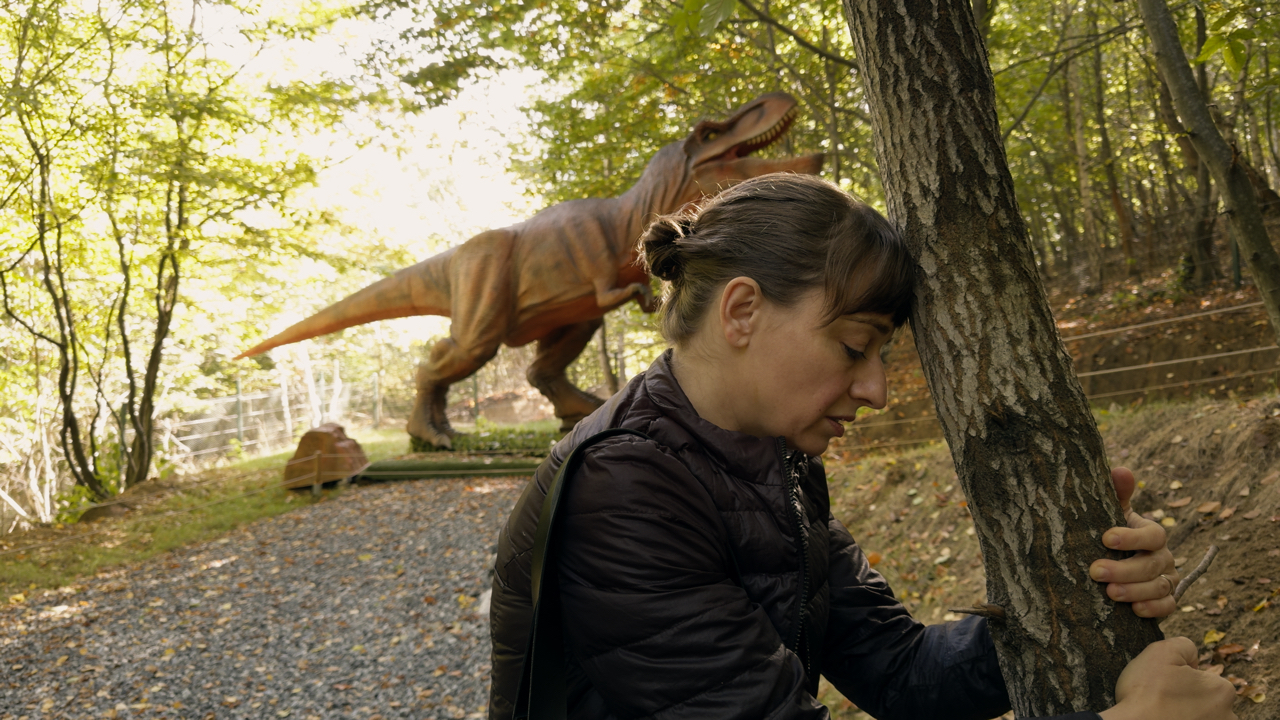
The film is about Grace (Lawrence), a married housewife that lives in a rural household and has a newborn baby boy. She is married to Jackson (Robert Pattinson), who spends most of his time away from “working” when he’s really just driving for long periods of time, stopping at diners, and flirting with the waitresses as Grace finds condoms in his glovebox. Jackson also unexpectedly brings a dog home for Grace, only for the dog to add to the film’s hysteria as he barks endlessly. The film opens with Grace and Jackson looking innocent, and they are definitely in love. The film opens up with them making love passionately, and they both look happy, youthful, and so full of life. We cut to the present day, and we instantly feel gloom. They now reside in a new home in Montana that was the childhood home of Jackson. They move into the home from living in New York City due to the cost of living. Jackson is often away from work, leaving Grace stranded and bored, and her postpartum depression begins to sink, which leads to some vulgar and crass behaviors towards others.
 Courtesy Mubi
Through some flashbacks, we are introduced to Jackson’s father Harry (Nick Nolte), who is suffering from some cognitive decline. They move into the house with Harry and Grace, Jackson, and Jackson’s mother Pam (Sissy Spacek) take care of him. Eventually Harry passes away, leaving the house to Jackson and Grace as Pam lives in a farmhouse nearby. Seeing Nolte on the screen again was a relief, he ignites in the scenes, but a few more scenes showing is breakdown would have certainly brought more resonances to Grace’s journey. The film ends up feeling like a chamber piece throughout as we follow Grace mostly though the house and we experience her hysteria and confrontations with Jackson. The two haven’t had sex for a long period of time, we see Jackson grow distant, and they both argue and shout at each other. Grace is also a published author of a book, but she hasn’t written in years, and the script by Ramsay and co-writers Enda Walsh and Alice Birch deserve praise for not using a subplot of Grace attempting to write again. Grace just tells fellow local housewives that she hasn’t had any inspiration to write again, and the film never aims to show her write as her writers block is long gone from her depression. Another fascinating aspect to the film is some of the abstractions of desire the film explores. In a lesser film, Grace would be promiscuous with other men to get revenge on Jackson for his infidelity, but here it’s left with ambiguities with a nearby neighbor named Karl (Lakeith Stanfield) who often drives by her home with his motorcycle and helmet, seducing her but the scenes feel elliptical, surreal, and unfold as they are Grace’s fantasies.
From there, the film hits the same notes, but I will say there are many great moments that are involving. For instance, there is a scene of Grace distancing herself from fellow housewives and mothers as the small talk feels hokey to her. She ends up undressing down to her bikini and jumps into a pool with kids nearby, who all jump in afterwards to draw the parallel of how adulthood is just a facade of forced small talk and pseudo kindness, and Grace can see right through the passive-aggressiveness of some people. It’s a very cynical viewpoint from Ramsay, but there is no doubt some truth to be found.
 Courtesy Mubi
I’m most impacted by the visual poetry of the film. Unquestionably, its impeccably shot by Seamus McGarvey. Through Ramsey’s conceptual visuals of Grace’s subjective reality, we see the world the way Grace sees it which feels like a mix of fantasy and other times it feels like a heightened fever dream of paranoia. Both the structure and visuals feel fragmented by design, and Lawrence’ delivers a fearless and towering performance that is both emotionally raw and vulnerable. Which brings me to a conundrum. The film offers no clues or insights of Grace’s depression. After smashing her head into a mirror, scratching walls, and falling into the patio window door. We are never given any insights of a character growth. She speaks to a therapist, who suggests she has a fear of abandonment, but everything is left very underwritten, almost on levels of it being lazy just to make it ambiguous for ambiguous steak. With that said, if its left just a study on depression then it succeeds despite having these shortcomings that would have made it even more emotionally rich. While the film is not profound, but there is a dramatic and visual momentum to the material that makes it engaging.
While the final act of the film is left unsatisfying, I’m not sure how well it will play on subsequent viewings, as the imagery feels forced and unmotivated. It leaves the viewer feeling the despair. You are left dazed and unsettled from Grace’s maddening journey in this. The film is certainly a tour de force for Jennifer Lawrence. It’s a bold performance in a bold film that is worthy of a serious discussion on depression, where Ramsay indeed shows care for the human condition, but in just more manic approaches.
Die My Love opens in theaters on November 7th, 2025


I’ve been very curious about this since I read about its existence. Looking forward to seeing it.
I heard Jennifer Lawrence was fantastic on this
I’ve been really wanting to see this because I’m huge fan of both actors especially Robert Pattinson… thanks for sharing your review . I cantbwait to see this!
Film is not for everyone. Very downbeat nd depressing, but Jennifer Lawrence is excellent s the lead. Many will find the film unsettling. 3 of 4 stars
I personally didn’t care for this film. I felt it was all over the place. The acting was great, but at times it was confusing. I thought it was a depressing film too.