

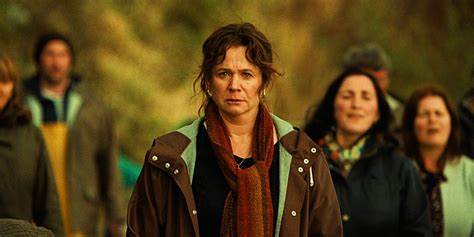

A superbly crafted work from the collaborating duo of Anna Rose Holmer and Saela Davis, God’s Creatures is a potent, somber examination of a mother struggling to come to terms with the fact that her son committed sexual assault against her fellow co-worker. The film takes its time in achieving the moral high ground and turns into an intricate and complex study about enablement, and just how challenging it can be to accept how the people in our lives who we are closest to could be capable of committing unsettling acts. While the subject matter is challenging, the film’s essential moralizing, earned character growth, and redemptive arc, along with a restrained, yet emotionally charged performance by Emily Watson, hold all the markings of being a satisfying drama.
In addition to being an impressive directorial debut for co-director Salea Davis, who has worked mostly as an editor, including for Holmer’s debut feature The Fits, God’s Creatures represents an accomplished sophomore achievement on her end with this compelling drama. The original screenplay by Shane Crowley in the first scripted feature film is also subtle and serves Homler and Davis’s observational visual style. The film does a deep dive into its exploration of parents dealing with their children committing terrible acts of crimes that is comparable to Fran Kanz’s Mass and Lynee Ramsey’s We Need to Talk About Kevin, which dealt with school shootings, where this film extensively deals with parents learning their son committed an act of rape.
 Courtesy of A24 Films
While Davis and Holmer avoid ever eliciting sympathy for the accused assaulter, it always sympathizes with the victim and highlights the difficulties of how family frequently sides with and enables the cruel actions through their denial. In this aspect, God’s Creatures adopts a moral conundrum of an approach of just how a mother could face the reality of her son facing such horrific accusations and eventually charges.
The film takes place on a coastal town of Donegal, Ireland. It’s mainly a fishing community, where men capture large amounts of fish from the sea, and the women work the factory cutting and exporting out the fish to supermarkets and restaurants. The waters are very rough during this season, which makes it easier to catch massive amounts of fish, but easier for fisherman put their lives at risk on the sea. Drownings are quite frequent in the community due to the heavy currents. What is startling about this is the community that they choose to be inactive in teaching people how to swim. They rationalize that if more people know how to swim, then more people will risk drowning if they try to save fellow fishermen from the aggressive currents. The essential theme of inaction is built-up in the beginning and carried out throughout the film.

The film highlights this with the films’ protagonist, Aileen O’Hara (Emily Watson). She is a foreman at the plant, and she doesn’t pry too many questions after her son Brian (Paul Mescal) returns back to Ireland after being gone with no trace for years. It’s quite strange why he returned, and he doesn’t discuss too much in detail about his experiences in Australia—which is where he resided for years—he’s in good spirits and chirpy, while Aileen is very cautious and observant. A crisis occurs in the family once an accusation of a sexual assault occurs, but Aileen still doesn’t take much action, shields him as an alibi, refuses to accept that he committed such a heinous act, and ends up creating some conflicting discoveries for Aileen throughout the course of her coming to terms with the truth.
Of course, law enforcement takes the case seriously at first, but the courts instantly dismiss the case due to a lack of evidence, mainly due to a lack of resources. The victim of the crime is Sarah (Aisling Franciosi), a co-worker at the fish factory who hasn’t shown up for work for 14 days, and Aileen fails to go to bat for her leave of absence. However, Aileen is a very observant person. She soon realizes how genuine Sarah’s anguish is when she realizes her son is far more sinister and depraved than she could ever imagine.

The film holds a lot of artistry that consists of a lot of eloquent moods with its cloudy forecasts, muted greys, and slow push ins. Watson’s performance along with Francisci both deliver very raw performances that express a lot of suppressed anxieties and anger with very little dialogue. There is another layer that seems omitted and not fleshed out enough, as the filmmakers prefer to use minimalism to capture the interior mindset of the characters. Minimalism can be effective, but for a story and build up like this the characterizations feel overly subdued.
The film is anchored by Watson. Her screen presence and unique traits have always been utilized to express vulnerability. These aspects are carried through even more with her most restrained and with the same dramatic impact with a gaunt, beaten down look that comes from aging and her job. Her marriage to her husband (Declan Conlon) appears to be happy, but other forces from her past and repressed emotions appear to be bottled up over the course of years. The filmmakers never directly dive into that aspect, and her character never fully feels as fleshed out as it could be. The character of Erin is also one-dimensional and deserves more layers than what the script provides.

The guilt builds on Aileen, especially once Sarah loses her job after being absent for a few weeks. Aileen’s sister-in-law, Erin (Toni O’Rourke), who was very welcoming to Brian at first, grows her suspicions as she understands the town’s misogynist attitudes and disregard of sexual assault. Sarah is even shamed by the community, and Aileen eventually finds sympathy and begins to realize she was in denial.
In the end, God’s Country is a thoughtful and well-acted film that examines the consequences of denial. It’s a film that examines and brings a lot of empathy, and what you’re feeling are the retractions of conflicting emotions. It’s insightful, unsettling, and quietly powerful. That also earns itself a redemptive arc in the third act, and the final reel reaches a rewarding catharsis of justice.




I might watch this. I like Watson.
Didn’t see this when I attended Cannes, but was able to see Coupez, Armageddon Time, Three Thousand Years of Longing, Men, and Tchaikovsky’s Wife
This does sound interesting. I like movies that revolve around a central issue, and how the various characters relate or are effected by the incident.
Nice plot. It’s educational and brings awareness to the audience’s that sometimes a complex issue is hard to be solved from both ends of the characters due to past and other things that the characters doesn’t reveal or being talked about. The culture is a big part, families do know each other well problem and it can be solved but when you are away for a long time from your own parents it becomes difficult to understand you more a person.
Hi defactofilmreviews.com webmaster, Your posts are always well received by the community.
Hello defactofilmreviews.com owner, You always provide helpful diagrams and illustrations.
Hello defactofilmreviews.com owner, You always provide clear explanations and step-by-step instructions.
Dear defactofilmreviews.com webmaster, You always provide useful information.
Hi defactofilmreviews.com admin, Thanks for the well-researched post!
To the defactofilmreviews.com owner, Your posts are always well-supported by facts and figures.
To the defactofilmreviews.com administrator, Excellent work!
Hello defactofilmreviews.com admin, Your posts are always on topic and relevant.
Hello defactofilmreviews.com owner, Thanks for the well-presented post!
To the defactofilmreviews.com webmaster, Your posts are always interesting.
To the defactofilmreviews.com administrator, Thanks for the well-organized and comprehensive post!
Hello defactofilmreviews.com administrator, Your posts are always well presented.
To the defactofilmreviews.com webmaster, Thanks for the well-structured and well-presented post!
Dear defactofilmreviews.com admin, You always provide great examples and real-world applications.
Hi defactofilmreviews.com admin, Your posts are always well received by the community.
Hi defactofilmreviews.com admin, Thanks for the well-presented post!
Hi defactofilmreviews.com admin, Thanks for the informative post!
Can you be more specific about the content of your article? After reading it, I still have some doubts. Hope you can help me.
Your article helped me a lot, is there any more related content? Thanks!
Бизнес – успех в компании Сибирское здоровье
Бизнес подход с Siberian Wellness не требует от вас первоначальных вложений личных средств. Для начала карьеры достаточно просто зарегистрироваться в качестве Консультанта и начать в своём регионе Самарская область
Siberian Wellness — международная Компания, выпускающая инновационные продукты для здоровья, красоты и спорта на основе дикорастущих сибирских трав и растений.
Каждый из участников Международной Бизнес-сессии получает работающие технологии и уникальные методики для успешного ведения бизнеса от лучших наставников компании.
Наша инновационная и эффективная бизнес-стратегия позволит вам увидеть первые результаты уже через десять дней.
Одно из ключевых направлений нашей Компании – разработка инновационных натуральных продуктов и функционального питания от 3_х лет до поддержки пожилого возраста.
Как стать партнером Сибирское здоровье?
Готовы к бизнесу, где здоровье и экология на первом месте? Siberian Wellness приглашаем тех, кто хочет изменить мир к лучшему, начать с себя. Присоединяйтесь к нашей партнерской сети. Получите доступ к экологически чистым продуктам, полезным ресурсам для обучения и персональному наставнику.
» https://multi-level-marketing.ru/
Почему стоит выбрать SIBERIAN WELLNESS и стать частью нашей команды?
» https://t.me/s/siberian_wellnass_rf
Компания Сибирское Здоровье, теперь известная как Siberian Wellness, появилась в 1996 году.
Регистрация в компании «Сибирское здоровье» в качестве клиента или консультанта открывает перед вами новые возможности. Вы сможете совершать покупки в магазинах и сервисных центрах, используя номер своей карты, получать скидки и экономить на семейном бюджете.
?? ИЛИ ??
Станьте привилегированным клиентом бизнес проекта Сибирское здоровье и получайте кэшбэк до 25% с каждой покупки!
SW