


Walt Disney. A Burl Ives TV musical. Italian animator Giuliano Cenci. Steve Barron, with 90’s heartthrob Jonathan Taylor Thomas. A Kevin S. Tenney slasher film. Steven Spielberg, somewhat. Roberto Benigni. Italian animator Enzo D’Alo. Roberto Benigni again. A Russian animated film headed by a bored sounding Pauly Shore. Disney again, by way of Robert Zemeckis. And a host of others. Film history is full of adaptations of Carlo Collodi’s 19th century fantasy novel, The Adventures of Pinocchio. It’s hard not to think that yet another version is the last thing that the world needs. But with his inventive imagination and grimly playful worldview, Guillermo del Toro proves that there’s always room for a new twist on an old tale with this stop-motion wonder.
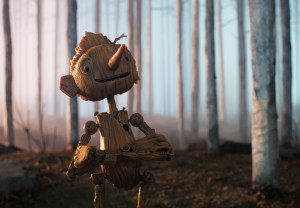
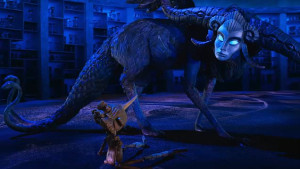
The changes to the story begin immediately. This version’s Geppetto (David Bradley) does not start out as a lonely old man. He is a raising a young son, Carlo. The two are inseparable, with the boy wanting to learn all about his father’s trade as a woodworker. But the pair have the misfortune of living during World War I, and while working on the local church’s crucifix, the church is bombed, and Carlo is killed. Geppetto loses decades to his anguish in a heartbreaking sequence where we see that he spends his days drinking under a tree grown from the “perfect” pinecone found years before by Carlo. Residing in this tree is Sebastian J. Cricket (Ewan McGregor), who fears the loss of his home when Geppetto drunkenly decides to carve a new son. In a turn showcasing the dark imaginations of del Toro and co-writer Patrick McHale (Over the Garden Wall), this film’s Pinocchio (Gregory Mann) is not lovingly crafted, but cobbled together in a fit of violent alcoholic rage, with motions mimicking those of a horror film. This Pinocchio, based on the visual style of artist Gris Grimly, is rickety with sharp angles. The back of his head is still mostly unfinished log and he spends the remainder of the film with nails poking haphazardly out of his back. But like the other versions of the story, a magical creature, here a sphinx-like Wood Sprite (Tilda Swinton) rather than a Blue Fairy, takes pity on the old man and brings the puppet boy to life. There are of course similar beats to past versions of the story, with Pinocchio disobeying Geppetto and taken in by a bad crowd. Here it is first Count Volpe the cruel puppeteer (Christoph Waltz) and his monkey sidekick Spazzatura, then later the local militaristic Podesta (Ron Perlman) and his son Candlewick (Finn Wolfhard). Pinocchio’s nose grows when he lies. Geppetto and Sebastian, and later Pinocchio himself, are swallowed up by a great sea beast. And lessons are learned and Pinocchio is able to become a living boy. But all of this is filtered through the mind of del Toro. In an early scene, Pinocchio follows Geppetto to church and is forced to leave. He asks Geppetto why all of the people love the wooden crucified Christ but hate him. Each time Pinocchio engages in behavior that would kill a human child, he is carted off by skeletal rabbits to an underworld ruled by a relative of the Wood Sprite. She allows Pinocchio to return to the real world, immortal, but he must wait longer each time to go back.
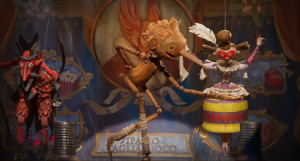
On a visual and technical level, this film is a masterwork. The work from del Toro and co-director/animator Mark Gustafson is largely traditional stop-motion animation with some added CGI touches. The design work is outstanding. Beyond the previously described Pinocchio, each character is lovingly designed. Every time a character returns to the screen, I marveled again at the level of detail and inventiveness given to each. Of special fascination to me were Geppetto, the Wood Sprite, Spazzatura, and the Black Rabbits. The film is incredibly beautiful and deserves to be seen on the largest screen possible. Another highlight is the score by Alexandre Desplat, performed solely on wooden instruments. The film is also full of songs, that while perhaps not Disney-level earworms, fit the tone of the story and add a layer of depth.
On a story level, del Toro continues his tradition of tying his films centered around childhood (Pan’s Labyrinth, The Devil’s Backbone) to a fascist regime. We are reminded time and again, including in a short scene with Mussolini himself, that Pinocchio’s characters are living in dangerous times. A dark late sequence involves the Podesta taking Pinocchio to a training facility for child soldiers, as it’s recognized that the wooden boy can die for his country many times over. Even the resolution is full of melancholy, as this Pinocchio is granted life but does not become a “real boy”. He remains a living puppet. As such, his mortality is questionable, as we see all of his family and friends fade away while he must carry on. The only complaint I have with the film is that it runs a little too long, with the run-ins with Count Volpe becoming somewhat repetitive. A tightening of the film by 10-15 minutes would have served to strengthen it.
Overall, Guillermo del Toro’s Pinocchio is a highlight of this fall’s movie season. It is in theaters now, and is available on Netflix beginning on December 9.





Can’t wait till it hits Netflix
This sounds utterly delightful and a strong repudiation of the live action Disney remake. Can’t wait to see it.
Not sure yet if I’ll watch this or not.
One of my most anticipated movies of the year from one of my favorite directors! Can’t wait.
Can’t wait to see it. The last few Pinoccio’s have been terrible. Plus del toro is pretty special to me
Absolutely worth seeing in the theatre if possible! Stop motion is an art that we don’t see as often as we should, but considering how much hard work and technicality is put into the art form the film is a marvel. Del Toro excels at the craft, story, and themes in a style of such a well known story that make it the pinnacle of all it’s tellings! Cannot wait to stream it again and again in December!
Now I wish I would have seen it in the theater but at least I got to see it! del Toro is one of the most accomplished filmmakers of our age. The stop motion technique has reached very high levels of art and we are the lucky ones. This was just as strong as Wes Anderson’s “Isle of Dogs”, another very challenging and enjoyable work. As I understand it, this stayed closer to the story in the book but I had no problem with enhancing and changing of the story. It was about 15 to 30 minutes too long but I was so engaged in the visuals it didn’t really bother me. By chance I caught the ‘making of’ doc on Netflix and it explained so much about how they accomplished this brilliant work.