

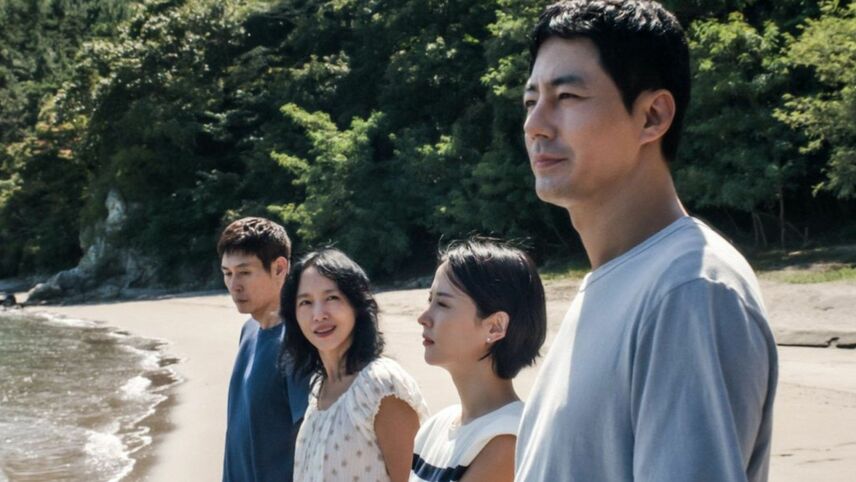

Lee Chang-dong’s long-awaited return with Possible Love is a deeply humane, staggering triumph that instantly establishes itself as one of the finest cinematic works of the year. Following the monumental achievement of Burning, Lee delivers a film that matches its predecessor’s structural precision while offering what is arguably the wisest, most observant exploration of socioeconomic inequality in contemporary Korean cinema. Where films like Parasite and No Other Choice leaned into heightened absurdity to illustrate class warfare, Lee scales back the theatrical madness, choosing instead to quietly dissect the quiet, devastating friction between two distinct social strata with profound emotional clarity.
What sets Lee apart as both a director and a writer is his rare ability to elevate social critique into rich, lived-in poetry. His screenplay captures the subtle mechanics of human interactions with extraordinary literary weight, balancing a sensitive eye for human flaw with a rare refusal to reduce his characters to simple moral caricatures. Under his direction, every scene breathes with patient, deeply felt empathy. His camera does not judge or sensationalize; rather, it sits intimately with the characters, holding on the lingering moments of stillness and unspoken embarrassment that reveal who they truly are when their defenses drop.
The narrative opens on a deceptively light, playful note centered on Ye-ji, a privileged documentary filmmaker who embarks on a passion project exploring blue-collar labor rights, union strikes, and the human cost of corporate downsizing. Her search for a subject leads her to Ho-seok, an unemployed factory worker whose livelihood was destroyed by layoffs, and his wife Mi-ok. Ho-seok is initially deeply reluctant to turn his personal ruin into public art, but he gradually succumbs to Ye-ji’s persistent intrusion and agrees to become the focal point of her film. In stark contrast to the struggling couple, Ye-ji returns home to her husband Sang-woo, an ultra-wealthy tech executive who functions almost like a smooth, charismatic corporate icon.

Courtesy Netflix
At the heart of the film’s sociological inquiry is a piercing look at how income inequality reshapes the human spirit. Rather than treating economic injustice as a dry set of statistics, the narrative explores how financial instability reshapes family dynamics, self-worth, and a person’s basic sense of dignity. Through a series of intimate sitting interviews between Ye-ji and Ho-seok, the full weight of these structural forces is laid bare. In these stunning exchanges, Ho-seok gradually drops his guarded exterior, recounting the traumatic aftermath of his factory’s closure and a brutal past confrontation with riot police during a union picket line. Lee handles these confessions with extraordinary restraint; with a quiet cadence of a man describing how a system designed to protect property treated his body and livelihood as entirely expendable.
These interviews expose a poignant paradox at the core of social documentary filmmaking: the gap between those who study suffering and those who must endure it. Ye-ji views Ho-seok’s violent clash with law enforcement as a powerful, necessary centerpiece for her thesis on corporate greed, while to Ho-seok, it remains an unhealed wound that haunts his everyday existence. By focusing on the unspoken power dynamic between interviewer and interviewee, the film offers a brilliant commentary on how well-meaning members of the upper class often consume the trauma of the working class as raw material for art, even while genuinely believing they are helping.
The cinematography plays a pivotal role in exploring this emotional divide, relying on natural light, wide compositions, and long, uninterrupted takes that allow atmospheric tension to build organically without artificial manipulation. This camera craft becomes especially breathtaking in the film’s extraordinary lake house sequence—the undisputed high point of the entire movie. When Ye-ji invites Ho-seok and Mi-ok out to their sprawling, isolated coastal retreat, the setting functions like a pressure cooker for unspoken resentment and well-meaning patronage. Reminiscent of intimacy-driven chamber thrillers, the domestic setting causes the boundary between empathetic artist and voyeuristic benefactor to completely collapse.

Courtesy Netflix
As the two couples share meals, navigate awkward silences, and drift across the surrounding grounds, the lake house becomes a physical manifestation of distance—a vast, beautiful prison of modern architecture framing people who cannot truly communicate. An unforgettable sequence by the water highlights this underlying tension, witnessed silently through the eyes of a young child who acts as a quiet, haunting observer to the adults’ implicit class posturing. Beneath the guise of generosity, Ye-ji’s well-intentioned curiosity begins to reveal the subtle, well-mannered exploitation underneath.
Supported by a razor-sharp script and extraordinary performances across the board, Possible Love exposes how modern economic divides erode human connection, self-worth, and genuine understanding. Through Lee Chang-dong’s extraordinary direction and immense storytelling grace, the film stands as a stunning, emotionally resonant masterpiece.
Possible Love is now playing in limited theaters





Leave A Comment