



Romeria, the new film from Spanish film maker Carla Simon, is a semi-autobiographical work about a young woman meeting her father’s family. Set in 2004, the film centers around a young person who needs to get a signature in order to qualify for a scholarship. Getting that leads her on a path of discovery, including how her past is now quite what she believes it to have been.

Courtesy Janus Films
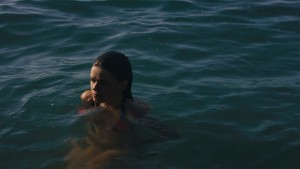
The film is shot in glorious, rich colors, set on the Atlantic coast of Spain. This allows many sequences, set in and around the water, to take place. It is a film about a pilgrimage, after all, for the title translates to that in English. The director chooses her shots wisely, emphasizing space and distance as well as perception, in order to strengthen the premise. She is aided in this by a gifted cast who bring the characters to vivid life.
Yet, this is a film that takes its time. It is a film which requires the viewer to pay attention and gives them a reason to care. The story builds itself slowly, with as much being said by omission as outright spoken, and the ways in which characters treat others is usually more important than what is said. The main character finds herself with a family she has never met, looking for an admission they are not ready to give.
Courtesy Janus Films
Each scene builds this and expresses these desires and hesitations. Marina, our point of view character, is played with grace and determination by Llucia Garcia, who also plays her mother in an extraordinary extended sequence which takes up much of the film’s third act. Here, the film proves that it is unafraid to bend rules or expectations and to defy easy categorization. It is no wonder, though, because magical realism is a trait in much of Spanish and Latin American art.
There is much about nature and nurture, but also the self and how we determine and accept or deny our place in our own existence. There is just as much about how others shape that by what they give or deny others. This is a serious work but it has deft and light touch without ever losing what grounds it. Indeed, as we get to know each member of her father’s family, we, along with Marina, come to laugh along with her at their tiny foibles and to grimace at their occasional horrible behavior.
This is, though, not quite a family drama, nor an ensemble, though it has the makings of one. It is, instead, a kind of cousin to the Bildungsroman of German literature, in that we see how Marina has a core sense of self which undergoes a major shift. She is smart and open enough to accept positive change and to not let the negative destroy her. Ultimately, the past is the past and she is not going to forget that or let it stop her but neither will she allow others to weasel out of being held to account.

Courtesy Janus Films
She has growing to do, though, and she does indeed go through it. As do others, but none to the same degree. Most importantly, her grandparents are forced to finally reconcile, however subtly but firmly, with the truths they have long buried. It is, in this regard, a film about overcoming pride and what extreme denial can do to a family unit. Should love come with conditions? Can acceptance include allowing others to harm themselves in front of you? It is a film that asks, and does not fully answer. Not out of some lack of having judgments or answers, but because, by the end, you know, without having to be explicitly told. Imagine that…a film that respects its audience’s intelligence.
Romeria is now playing in select theaters.





Leave A Comment