


Claire Denis’s sensual and tense adaptation of the late Denis Johnson 1986 novel, Stars at Noon, is a stylish, sophisticated, genre-bending reworking of the espionage geopolitical thriller. On the surface, it has all the espionage movie tropes, but Denis once again deconstructs the genre and chronicles a sensual narrative about colonization, globalism, intimacy, and love. This now marks Denis’s second non-French film after the 2018 sci-fi mind-bender High Life, and with Margaret Qualley delivering a transfixing performance as a U.S. exiled journalist who’s trapped in modern-day Nicaragua who falls in love with a British businessman and gets caught up in his political subversion and business dealings. Like Denis’s other dramatic feature released over the summer, titled Both Sides of the Blade, the film’s setting is in the modern day of the COVID pandemic era, which actually ends up serving well as a highly engaging background setting for the story.
The casting of Qualley, in which she progresses as the film goes on, is something of a double-edged sword for international directors working with actors outside of their native homeland. On the downside, a lot of the filmmaker’s communication barriers can be misdirected, and the interpretations of what the actors want to seem more at odds with the filmmaker’s end vision. On the plus side, Qualley comes around very quickly, and what appears to be a miscast at first, ends up being a layered and vulnerable performance. While a lot of motivations might appear to be muddled or unclear, Denis implicitly imbues the sensory and elliptical over the expository. This is all thanks to Denis’s powerful camera observations and luminous imagery, accompanied by gifted cinematographer Éric Gautier (Motorcycle Diaries, Ash is Purest White), who also shot the exceptional Both Sides of the Blade as well.
 Courtesy of A24 Films
The films setting of COVID with scorching hot weather in Central America, where most citizens are masked up as we see militarized police patrolling the streets, heightens the film’s purgatory tone like ether. Stranded with nowhere to go, we follow Trish (Qualley), a Washington, D.C. journalist who no longer reports but feels like an exile or even transplant who clearly has withdrawn her commission as a journalist. She lives day-by-day by visiting local bars that have air conditioning and exchanging her body with a Nicaraguan army lieutenant (Nick Romano) for shelter and safety. You can sense she doesn’t quite enjoy the intimacy with him, but he’s young and handsome enough not to be repulsed, but you can sense she’s a lost woman who longs for something more. She’s trapped in the country; he uses her sexual exchanges as a form of protection for her not to be turned over to the authorities.
Once the lieutenant goes on duty to another region, Trish gravitates toward greater threat, danger, and eventually pleasure and love. She ends up encountering a wealthy British oil company consultant named Daniel (Joe Alwyn). Their first encounter is at a bar as armed soldiers patrol the streets and the local hospital is filled with severely ill COVID patients. Aesthetically, Denis’ luminous visual style flourishes with a mostly sterile feeling. Using mostly wider prime lenses with tighter shots and even wider shots, this adds to the characters’ confinement to this COVID-induced world that also consists of political mayhem and human suffering. Each time Daniel and Trish are together within shots, you can feel the tensions rising in the outside world that eventually bonds them together from their spatial disconnect. You can also sense a sexual tension brewing between them that is just waiting to be released.
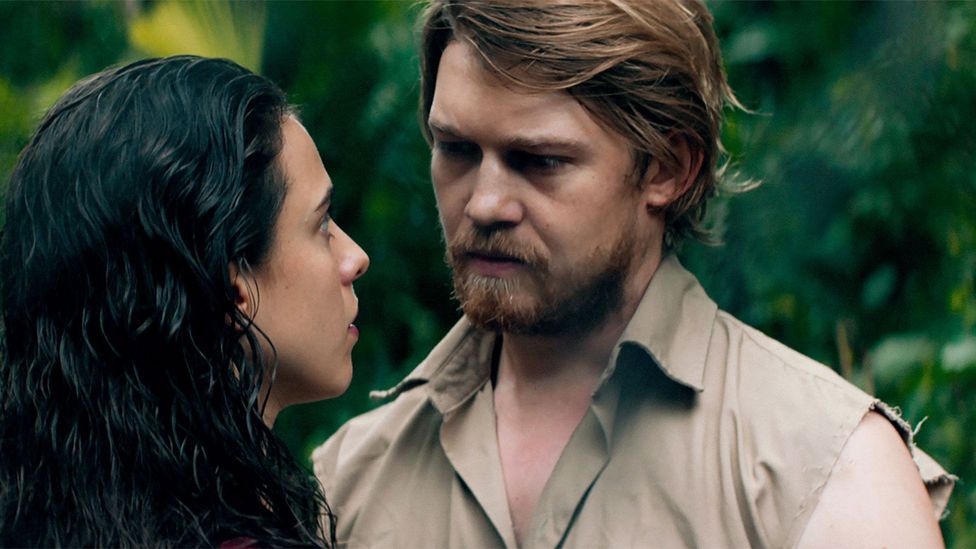
They both form a strong attraction, and Trish can sense he’s a man of money. He holds crisp dollar bills that are treated like gold. Both Daniel and Trish’s intentions dive deeper than just psychical attraction and sex. Eventually, they both discover they are using each other as pawns to get each other out of the aggressive foreign territory in hopes they can cross the border into Costa Rica, where they can retrieve their VISA and passports at the embassy. Outside of these motivations, Denis’ narrative is left muddled, and we’re never given too much backstory or exposition on Daniel’s funneling, other than that he’s certainly involved in potentially funneling money to citizens who want to spread freedom and democracy away from a corporate enslaved autocracy that props up military dictatorships and fascism that dry up the nation’s own petroleum resources. As for Trish, we never fully understand why she is trapped in limbo or why she can’t get out of Nicaragua. We have this year’s most insane cameo by a familiar American actor. I won’t spoil who plays Trish’s boss, who lectures Trish on a Skype call about wasting the advance money he gave her in which he never received the coverage that was promised to him. He refuses to give her an advance to cover more stories. which leads Trish to just live moment-by-moment and day-by-day.
Outside forces, including local law enforcement, the American CIA, and other military personnel, are also following and caving in on Daniel. Knowing their options are limited, they hide out in different hotels together, jump taxis, drink at bars, and eventually make passionate love together in sweaty, hot hotel rooms. Their desolation and independence for so long allows for their company to feel dependent. Even brief breaks for cigarette breaks or meals, or even a moment when Trish walks into a purple neon dance floor with Tindersticks playing in the background without Daniel makes her feel that alienation again. Denis rather demonstrates how their company has now become a necessity as crises exist outside of them, both from the pandemic and from other external forces outside of their control. This goes to show how lonely and vulnerable one can feel when they have no control, when they feel the world collapsing around them.

What we have are two characters who are incapable of going separate ways. They both need each other to get out of the nation, and it becomes apparent that their love and passion together might be short-lived and spontaneous, but it’s genuine. After stealing a vehicle and stopping into a town just outside Costa Rista border, Trish ends up encountering a fellow-American named in the credits as “CIA Man” (Benny Safdie), who offers her cash and her passport back to the country if she exchanges information and helps turn him into the Costa Rica authorities. Trish’s refusal to cooperate and side with Daniel when she knows he’s doing something noble with his money.
The plot and running time are certainly ill-advised, which is ironic considering most Denis films always wrap up at the right running time. The film’s 137-minute running time is demanding, at times meandering and repetitive, but Denis adds enough flourishes to keep it from feeling demanding or sluggish. Especially with how she grounds the 2021 COVID-induced world where Trish and Daniel’s escapes feel like interludes that are disrupted as they wander through a parade of mourners wearing masks, and the COVID-testing site where they must get tested before entering the border is one of the most impressively staged scenes to be delivered this year.
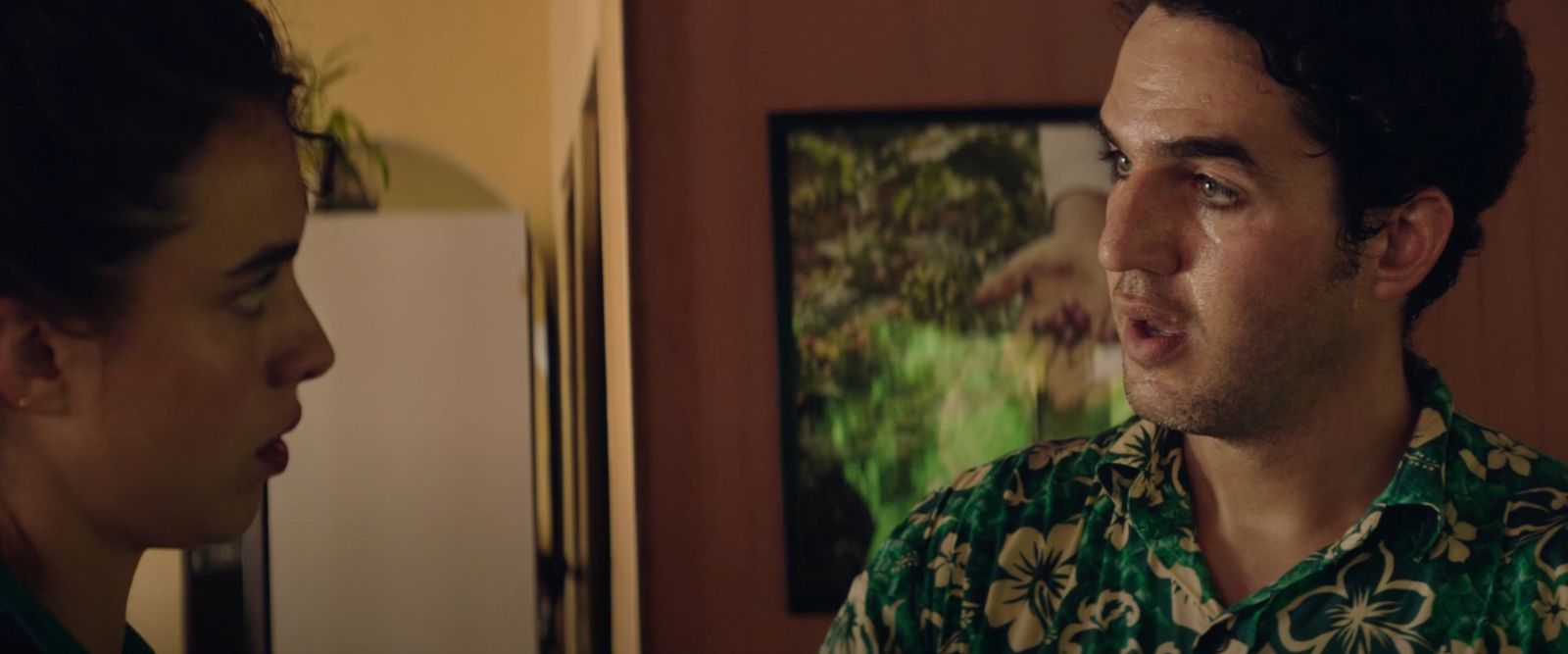
The parallel theme of colonist atonement, which has often been explored by Denis before with Chocolat, Beau Travail, and White Material, is clarified in Stars at Noon, which becomes an array of many other ideas about two charters trapped in a purgatory of guilt, oppression, and other external forces of suffering that their apathy helped create. Denis examines, with compassion, two lost people whose alienation, complicity, and eventual rebellion are eventually going to be expiated. For Trish, her negligence in reporting on the truth created her alienation, and for Daniel, it is complacency for putting profits and resources over people, which leads to him rebelling and channeling money to other companies that would be more supportive of democratic causes for the damage he helps create. If this material had been in anyone else’s hands, it would have been a generic geopolitical thriller. Instead, Denis shapes the material into an artful exploration of existential alienation and mutual salvation.
Like all of Denis’s films, Stars at Noon shimmers in the mind with its elliptical imagery and sensory tone. Her style once again preserves the compelling story of a highly regarded novel and elevates the material by merging deeper ambiguities with an intriguing mysteriousness. Visually, this also compares with Both Sides of the Blade as both films rank up there with Denis as being her most intimate since 35 Shots of Rum. The cinematography here is striking–as the camera drifts through bars, hotel rooms, rivers, and observes the human body, which her style has a voyeuristic ether to it this time around. Ultimately, one will be fascinated with this film on a visual level, perhaps transfixed by some of the plotting, and yet it impresses once again with Denis’s measured artistry.
Stars at Noon opens in theaters nationwide and at Cinema Detroit Friday, October 14th.
www.cinemadetroit.org




Excited to watch it
Looks like a good film, thank you for the great review, Robert.
Movies like this one did great in the nineties. It was the type of film’s audience wanted to see. Because if this kind of films didn’t made money in theatre, dvd distribution was more considered a second distribution. Then technology got advanced. DVD kinda faded away. That’s why superhero movies was the thing to keep at it every couple years or so. The plot looks good and well casted.
Looks really interesting! I’ll have to check it out. Thanks for the review
As always, thanks for your comprehensive and thorough film review. Yes, I will have Freedom Fries with my order. Yes, I will go see this Spanish/ English Film with English Subtitles/ Screenplay and Directed by Award winning French Director Claire Denis. It is one of the 2022 Winners of the Grand Prix prize at Cannes. The buzz is that this film “Stars At Noon,” is billed as a contemporary romantic thriller based on the book of the same name, first filmed in Nicaragua, and then shooting moved to Panama due to political unrest. This stars Benny Safdie, John C. Reilly among other fresh faced inge’nues. Looks promising…
I’ll see that. Looks good.
Thanks for the usual insightful and thorough review.
I’m a huge fan of this cast and I’m liking the sound to the plot. I will be sure to check this out. Thanks for the great review!
Really dug its early Wong Kar-wai feel. Thanks for sharing this.
This is the first film that has come to my attention that includes a COVID storyline.
I would be interested in seeing how the pandemic is depicted outside the American battlefield.
Excellent write up! You helped articulate a lot of things I was having a hard time coming up with in my thoughts of the film. Denis really loved her leads in this film. She really put them out there in this film and it was surprisingly sensual in a few scenes. They really grew a great kinship with their parallel dilemmas that I was fully invested with them getting out together and that really made the film flow as well as it does instead of drag. I do wish there was a lot more information given to us and sooner than they did. I think it would have worked a lot better for a lot of people and their experiences with this film in the end. Also, you gotta love the moment you see Safdie you know this is not a good thing for them at all. The Covid aspect of everything was also wonderfully done. No one in the states could ever complain about our policies after seeing how hardcore Cuba was going with it.
I want to watch the game of thrones in 2 days with shortening summary review. check it out
Reading your article helped me a lot and I agree with you. But I still have some doubts, can you clarify for me? I’ll keep an eye out for your answers.