


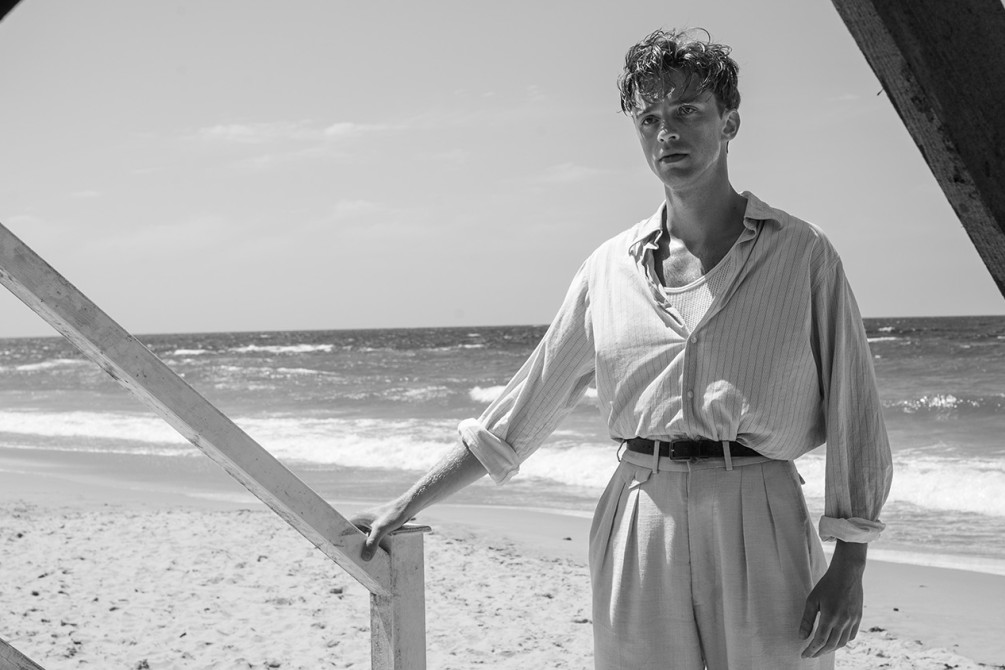
It’s no surprise to find that Wes Anderson returns to his singular style and traits that he is celebrated for with The Royal Tenenbaums and The Grand Budapest Hotel being his highlights, yet his distinctive traits are accelerated to an event greater extent with his latest film, The French Dispatch, except it’s perhaps his most ambitious and inventive film yet. With a lot larger budget, more elaborate set-pieces, and even utilizing different aesthetics, for once Anderson gets outside of his comfort zone in some of the style as he attempts to utilize some more off-balanced frames, high and low angles, black-and-white cinematography, some unique French amination, and there is even a scene where Anderson goes off the tripod and actually stages a scene handheld.
It is quite refreshing to see Anderson trying new things while still staying true to his sensibilities. It’s almost as if Wes Anderson is thumbing his nose at his detractors by utilizing his most uncompromising and passionate vision to date. The French Dispatch is to Wes Anderson as INLAND EMPIRE is to David Lynch, a love letter and rather thank you to his fans who have been embracing his body of work for the last 25 years. It is perhaps his most potent and dizzying film he’s ever made. It’s not the type of film you would recommend to someone who wants to dive into the work of Anderson as their first film of his that they watch, you do have to build up a tolerance for it. For instance, a Lynch fan wouldn’t recommend someone watch to start off watching INLAND EMPIRE as their first Lynch film, you have to graduate and start off with the more accessible ones first.

It’s not to say The French Dispatch isn’t accessible or even demanding, but the film holds a lot of energy, and it can certainly feel overstuffed with so much coming at you all at once. It is no mistake that a clock appears as a metaphor in the film, as Alexandre Desplant’s score amplifies the material just as Jon Brion did with P.T. Anderson’s Punch-Drunk Love. In other words, The French Dispatch is rapid and moves along very quickly, this is the Wes Anderson film that is equivalent to a whiplash. It isn’t quite as endearing as Anderson’s works. It doesn’t have the family dynamics of The Royal Tenenbaums, or the childlike quality of Moonrise King, or even the human pathos of The Grand Budapest Hotel, his latest film is more of a labor of love where he pushes the limits of how far his style can take him. Wes Anderson is appearing to be in that period of a director’s life just as Brian De Palma was in the 80s and Fellini in the 60s or 70s where they want to push their creativity and the result will be dismissed either as pretentious, unique, or brilliant.
For the record, I commend just how bold Anderson can be with his style. It almost feels like a swan song to his style (I can’t imagine just how much more he can do with this style), but it’s a unique experience and Anderson takes more bold chances than ever before in terms of structure, aesthetics, and even approach. This will be Wes Anderson’s most polarizing film yet, as he is now at the point of his career where he’s trying to make greater chances as he tests uncharted waters in how audiences and critics are going to react. It’s almost as if all the great Wes Anderson traits are here, as in just about every Anderson film, but this time he’s made a film of artistic growth. The film has all the Anderson touches and tasteful exquisiteness, and there’s an element of elegiac maturity in its themes about a fading world of a printed press that actually valued writers as well as the written pros. The film is an ode and farewell to journalism and magazines they were co-opted by mega-corporations and eventually reduced to internet articles and online videos.
Perhaps his most self-aware and even most artificial live action film since the polarizing and flawed The Life Aquatic with Steve Zissou, but he allows the audience to actually connect with it more on an emotional level. While not as emotionally resonant as his greatest efforts like The Royal Tenenbaums, The Grand Budapest, Rushmore, or even Fantastic Mr. Fox—The French Dispatch keeps the audience in an imbalance–it holds our attention by celebrating its artifice and by also playing tribute to authors, writers, and the power of storytelling. While utilizing his deadpan hilarity into full impact here, the audience I screened The French Dispatch with laughed, applauded, and absorbed themselves in some of the more poignant moments that just demonstrated how Wes Anderson still has the talent to fill a human connection to his work while still honing in his artifice.
To that impact, The French Dispatch is an absorbing, effectively somber film–but outside really diehard Wes Anderson fans I do not think it will be film that will unite critics, moviegoers or even all moderate Wes Anderson fans, but it will more than likely divide audiences and join the ranks of other auteur driven films like Fellini’s Amarcord, De Palma’s Body Double, David Lynch’s INLAND EMPIRE, Lars von Trier’s The House that Jack Built, Sofia Coppola’s Marie Antoinette, Andrei Tarkovsky’s The Sacrifice, Scorsese’s After Hours, Sergio Leone’s Duck, You Sucker, Quentin Tarantino’s The Hateful Eight, and Nicholas Refn’s The Neon Demon that will be more savored and appreciated as time passes on. This is Wes Anderson’s fine wine film that could very well be ahead of its time. Anderson is a very sophisticated, skillful director –which many dismiss as a one-trick pony–but if they look closer, they will see a more complex yarn that is meticulously staged on all levels. I’m enthralled to see Anderson can take his direction to new and exciting levels, while still staying true to his vision.
To that record, there has always been a yearning for the past in all of Wes Anderson’s films–even his more modern ones his characters are dressed as if they exist in a Jacques Tati or François Truffaut French film. Anderson’s characters always live in a world of the past. In The French Dispatch, he amplifies these passions even more. It’s an anthology piece, very much like Kelly Reichard’s Certain Women, or the Coen’s The Ballad of Buster Scruggs, which was a very solid film that had three great shorts as the last two were draining and exhausting. In The French Dispatch there are only three short stories (including a very small monologue and epilogue) that chronicles a group of American writers who resided in a fictional French named Ennui-sur-Blasé. All three shorts are all very satisfying in their own different ways.
Visually arresting and intricate in plot and theme–The French Dispatch is a rarity and one that will require repeat viewings for a deeper analysis as so much is going on in many levels. On the surface, the film feels like you are just getting another Moonrise Kingdom or Grand Budapest Hotel. Yes, you get the symmetry, the balanced frames, rich décor, and exquisite cinematography by frequent Director of Photography Robert Yeamon. Anderson returns with his frequent A-List of actors that he’s used in the past before with Bill Murray, Owen Wilson, Jason Swartzman, Adrian Brody, Saorise Ronan, Frances McDormand, Edward Norton, Tilda Swinton, and Willem Dafoe. There are also some new faces he casts for the first time with Benecio Del Toro, Jeffrey Wright, and Timotee Chamalat. Also, what comes with this is melancholy–which the lonely souls try to overcome their emotional suffering through records and leather shoes All of this should feel familiar and self-parody by now. Yet, Wes Anderson has a way of winning you over by drawing a human connection that makes his vision once again feel deeply personal.

The French Dispatch is also Anderson’s most romanticized film to date. He bemoans an era where writers were valued, paid well, weren’t reduced to limitations, had more creative freedom, and were valued by their employees before the era of mega-corporations bought out magazines and the press. With a setting in the 1960s, with aesthetics that resemble the look of Jacques Tati Monsieur films. The film opens in the prologue with a narrator (Angelia Huston) celebrating the life of fictional editor Artur Howitz Jr. (Bill Murray), who is a very stern and strict person who values journalism, storytelling, and writing. He runs a newspaper out of an office building that was originally started as a small outlet newspaper in Liberty, Kansas. The film transitions over to the papers travel writer Herbsaint Sazerac (Owen Wilson) who guides the audience into the history of Ennui-sur-Blasé’ town history that consists of rat tunnels, gentrification, and a river that always has the same yearly body count no matter how much more of the population grows each year. The first chapter of the story before the prologue that introduces The French Dispatch is titled The Concrete Masterpiece – by J.K.L. Berensen, in which each chapter serves as the The French Dispatch’s magazine articles.
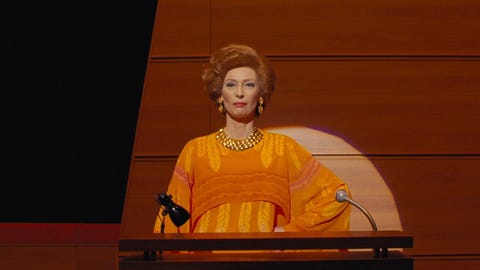
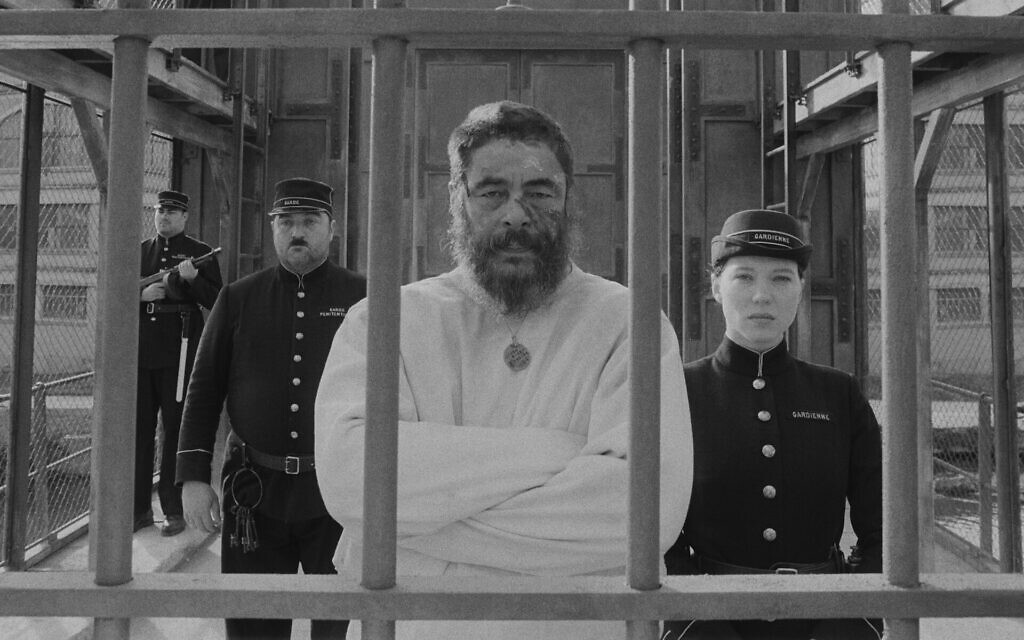
Tilda Swinton plays JKL Berenstein (Tilda Swinton) who narrates to a crowd about Moses Rosenthaler, renowned painter Benicio del Toro as Moses , an incarcerated abstract painter whose muse and lover Simone (Léa Seydoux) just also happens to be his prison guard. Moses is in prison for double homicide after killing two men in self-defense once he noticed they were bullying an elderly man in a bar. Simon also serves as his promoter who Julian Cadadazio (Adrian Brody) is in awe of Moses’s artwork and wants to represent him in the art collecting world. He also wants to use his status and wealth to get Moses out of jail. This segment is very involved and holds some of the most satire out of the three while also delivering some strong characterizations with the Moses character. The chemistry between Moses and Simone (Seydoux) is more convincing than the chemistry between Craig and Seydoux in the last few Bond films, perhaps because Seydoux is more comfortable in the art-house realm other than big-studio blockbusters.

The second story titled Revisions to a Manifesto – by Lucinda Krementz is perhaps the most comical and whimsical. It takes place during the 1968 student protests in Paris, which certainly feels like a more fanciful version of Bernando Bertulluci’s The Dreamers This segment of the story features Timothée Chalamet as Zeffirelli, an idealist and revolutionary who wants to start his own manifesto, who also is attracted to Lucinda Krementz (Frances McDormand), an editor and writer for The French Dispatch who helps edit and guide him in his writing of the manifesto who feels her objectify is compromised once she guides Lucinda in what he should write in the Manifesto. There is also a very cleverly done ambiguous touch that plays on just how far their relationship goes as Zleffirelli likes to think he is romantically involved with Lucinda, as Lucinda feels like he’s mistaken their planktonic friendship for something deeper. Zeffirelli is also writing the manifesto in hopes it can touch the heart and mind of Juliette (Lyna Khoudri), a student revolutionary who is every bit as passionate about the revolution as Zeffirelli is.
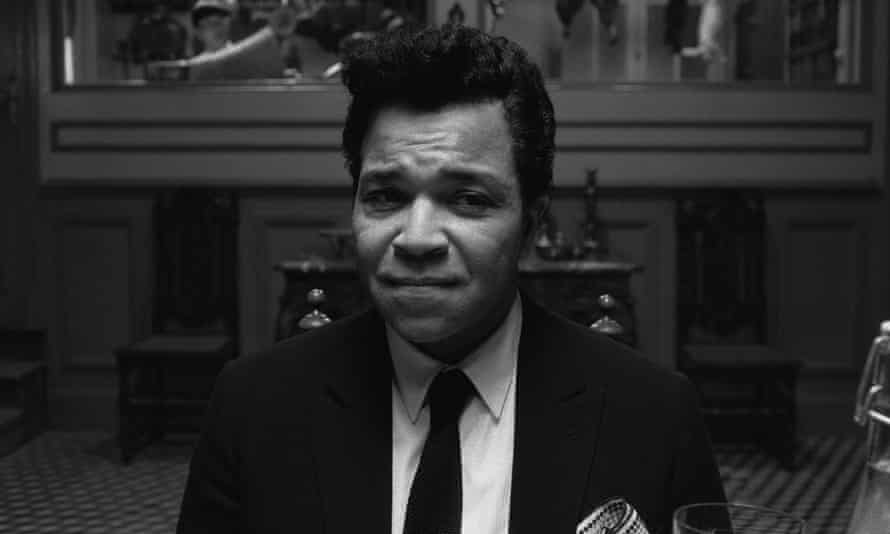
The third and final story titled The Private Dining Room of the Police Commissioner-by Roebuck Wright, features a writer and sonorous voiced author named Roebruck Wright (Jeffrey Wright), who recounts his story exactly how he wrote i6 without reading it from The French Dispatch magazine as he recollects the story to a talk show host (Liev Schreiber). He remembers the time he had a private dinner with the Police Commissaire of Ennui (Mathieu Amalric) in which the dinner gets disrupted once Gigi, the Commissaire’s son is kidnapped by a disguised Chauffer (Edward Norton) and held ransom by his syndicate. The Commissaire’s police Lt. Nescaffier (Stephen Park) is put in charge to negotiate with the kidnappers’ demands and provide them and Gigi with food. This vignette of the film holds the most resonance as it offers the most emotional payoffs. Both Park and Jeffrey Wright are terrific in their roles and they both carry out tender moments that reach some deep sadness and character depth.
Collaborating again with Roman Coppola and Jason Schwartzman in the creative process, Anderson delivers his film, which the first-rate set design by Oscar-winning production designer Adam Stockhausen and another frequent Anderson collaborator, once again gives the film a deliberately polished and deceptively artificial look. With Yeoman’s masterful cinematography and Andrew Weisblum’s skillful editing merged with Alexander Desplat’s luminous score brings great energy and momentum to the storytelling.
The film earns its touches and still feels fresh with Anderson’s idiosyncratic details, while still accentuating its deadpan hilarity. Measured with a more bold and elegiac approach by Anderson this time around, as he plays wonderful tribute to the writers and their intricate bonds with Arthur Howitzer Jr. and other acquaintances of their past memories. Anderson once again takes the audience through a very intimate and mournful journey. Highly inventive, The French Dispatch certainly comes with what you would expect from Wes Anderson, but it feels every bit as remarkable as The Royal Tenenbaums and The Grand Budapest Hotel did with his style. I admit to being skeptical of “The French Dispatch” just being more of the same, but Anderson pulls it off once again with a more confident vision that still feels alive with wit and spirit.

I will be at the theater the day it’s available. I adore Anderson’s films.
Thanks for the review. I’m looking forward to seeing it. How many comments do you get on this site? I’ve noticed the comment section on other reviews you’ve written. Just curious.
Yes, I’ll see it. I enjoyed his last film, “Isle of Dogs,” but unlike the majority of people I know, “The Grand Budapest Hotel” didn’t totally sell me. I’m an odd duck. Two of Anderson’s most maligned films I happen to enjoy the most: “The Life Aquatic” & “The Darjeeling Limited.” The former I love due in part to its Jacques Cousteau-influence. I also dressed as Alistair Hennessey (Jeff Goldblum) on Halloween night in ’08 while my friends donned Team Zissou uniforms. Traitors.
Saw it twice, good film though not his best. Second viewing was easier, it’s pretty dense with information.
No more Wes for me. Unless somebody convinces me it has absolutely nothing in common with anything else he ever made.
To compare him to these other filmmakers one after the other is rather lazy and dismissive as to why people don’t like him. He has no soul. It’s artifice and shots and rather cold. He has talent for a scene for rich people with no real problems, and in my mind, it’s not art, but stage for greater problems of which he knows nothing. It’s shit
I was invited to a pre-screener last Wednesday, I so wanted to love it, I don’t believe it’s his best work, yet if you are a fan it’s worth the watch
I know it’s a cliche, but his first three are still his best. Maybe something about co-writing with Owen Wilson kept him earthbound.
Beautifully made, just too much information at this time of day for me to process.
Gonna watch it again before I pass judgement.
Saw it on Monday it is a feast for the senses
Saw it on Sunday .n will most likely see it again next week with different friends
Hoping to catch this on Saturday
A must see for me.
Absolutely brilliant. It truly is about the art of storytelling and storytellers. Makes you long for the days of independent magazines and newspapers and sad for our current news consolidation and focus on corporate interests. There was truly magic in the stories in addition to directorial ‘Wes magic’. I was riveted all the way through.
It was amazing. I have some vision issues so the subtitles being small and all over the place were a little annoying for me, but the movie it self was fantastic.
I agree with this a lot, feels like West has perfected his style and now is taking another step forward with his ambition. I love his usage of playing with storytelling and the expectations it entails. This is my favorite one from him in a long time. And I also love that it’s been yet, I’ve always felt he should do a vignette piece since his style is perfect for it
My new favorite of his films!
I had the BIGGEST BLAST WATCHING FRENCH DISPATCH!! never knew that I’d really enjoy the heck out of this film!! After 18-19 months of the film’s postponement, I couldn’t thank Wes enough for another creative film he has finally released!! Yes, I don’t believe that this is Wes’ best film. BUT, it is the most creative I’ve ever seen from him!! His passion for French cinema was heavily present and I couldn’t help but gaze at the screen! His tributes to Jean Luc Goddard, François Truffaut, and Jean Paul Melville were very noticeable and I loved it!! I honestly hope to rewatch The French Dispatch!!
Welp….for the first time since December 2019, I sat in a theatre to take in a film. It had to be The French Dispatch. A terrifically Wes-flavored presentation. Visually and musically, so very him. Storytelling wise, something new, which I very much enjoyed. Looking forward to a second viewing. Hope everyone gets a chance to see it in the not-too-distant future! Great review!!
I just got back from seeing The French Dispatch and I have no idea how I feel about it. I saw it at my local art house cinema and that seemed to be the consensus of the other theater goers as well. I’ll definitely have to see this a second time, maybe on Sunday actually. I didn’t care for The Life Aquatic at first either and now it’s one of my favorites. Plus they have a specialty French Dispatch cocktail I have to try
Love the review I’m personally not a Wes Anderson fan specifically his style of directing and writing respectfully I respect him as a established award winning film maker and I’m going to watch it. I also thing Timothy is a over rated actor minimal emotion compared to how people write about his performances he mostly has the same emotion just attractive so sells a lot as it goes for slot of actors sadly these days.
I’m looking forward to seeing it. I know Wes Anderson takes a lot of heat in some circles for his style of story telling, but I absolutely love his movies. He’s easily my favorite filmmaker.
Another hit from Wes! The Concrete Masterpiece is Wes at the absolute top of his game. It never feels to much but almost to little, could’ve watched another two hours of it. I do think the Private Dining Room vignette isn’t on par with the other two, but Steve Parks final lines give the film a beautifully poetic end. A beautiful composed, shot, and innovative piece of art!
I thought it was so amazing . Keep up the great work.
Just finished watching The French Dispatch. We enjoyed it quite a bit. It’s very funny, and slapstick-y, but not a very tight film. To say it has a high concept is an understatement. He does that thing he did at the beginning of Hotel Budapest where it starts out about the author, the pulls back, and then pulls back yet again to finally reveal the story that the author is telling you. In this case he does it three times, each time the writer gets a bit more involved in the event that they’re writing about.
One thing I’d do before you go see it is look up the French student protests of 1968. I could see how that part of the movie might fly over some people’s heads.
I kind of feel that this film is sort of his “Greatest Hits” as he seems to have employed every single style he’s ever had in one film. Even animation.
Definitely not my favorite, but one I’d still watch again. I just feel like he keeps everything at arm’s length. It becomes more like a Wes Anderson curiosity more than something to get deeply involved in. I get that a lot of his films are a little like that, but this one even moreso.
I loved it and am still processing it. The casting, the performances, the writing…it blew me away. I can’t wait to see it again!
Great review!w
Monday 10.30AM screening in a suburb of Manchester, UK. Never been to the cinema alone before. I wore a red barrette in tiny tribute to Margot Tenenbaum but felt like a foolish ‘old maid’ in front of staff half my age! Enjoyed many elements of the film – many little moments of humour, from the slapstick to the subtle. Very enjoyable storytelling and beautiful visual set-ups, as you’d expect. Jeffrey Wright was the highlight for me.
The most Wes Anderson-y movie of them all! And I mean this as the highest compliment! Many complain that Anderson is just copying himself at this point. First of all, who else has such a distinct style? Also, who has more original storytelling? Who could have predicated where any of these little vignettes were heading? The familiar faces were great, but the newcomers (Wright and Del Toro were exceptional). Anderson is certainly entering a a new phase with this masterwork.
Robert Butler this is one of the more insightful reviews I’ve seen for the film, great job. French Dispatch is definitely a love letter to the fans, if anything and would be nauseating to anyone trying to jump into it as their first encounter with his work
Soooo, after so much anticipation, I finally took myself on a single person date with my lovely beret, to watch The French Dispatch. It was glorious. Needing to go back Pronto to rewatch it.
Masterpiece!!!
Went to see last night. I think this is his most interesting work to date. Not as accessible as most of his previous creations. Very dark. It reminds me of The Darjeeling Limited in some ways.
Great review Rob!
Going on the record that I absolutely LOVE “The French Dispatch”, Wes Anderson’s brilliant new film. If you can, see it now, in a theater and be totally amazed. This is a master artist at work.
Saw the French Dispatch with my daughter last night, it was funny, a bit more awkward than his other films due to the vignette style I think. Weird, silly, and beautiful. Not my favorite but still hit me in my Wes Anderson bone. Not sure why Elizabeth Moss was in it at all, tho.
Anyone else felt the value just like me?