

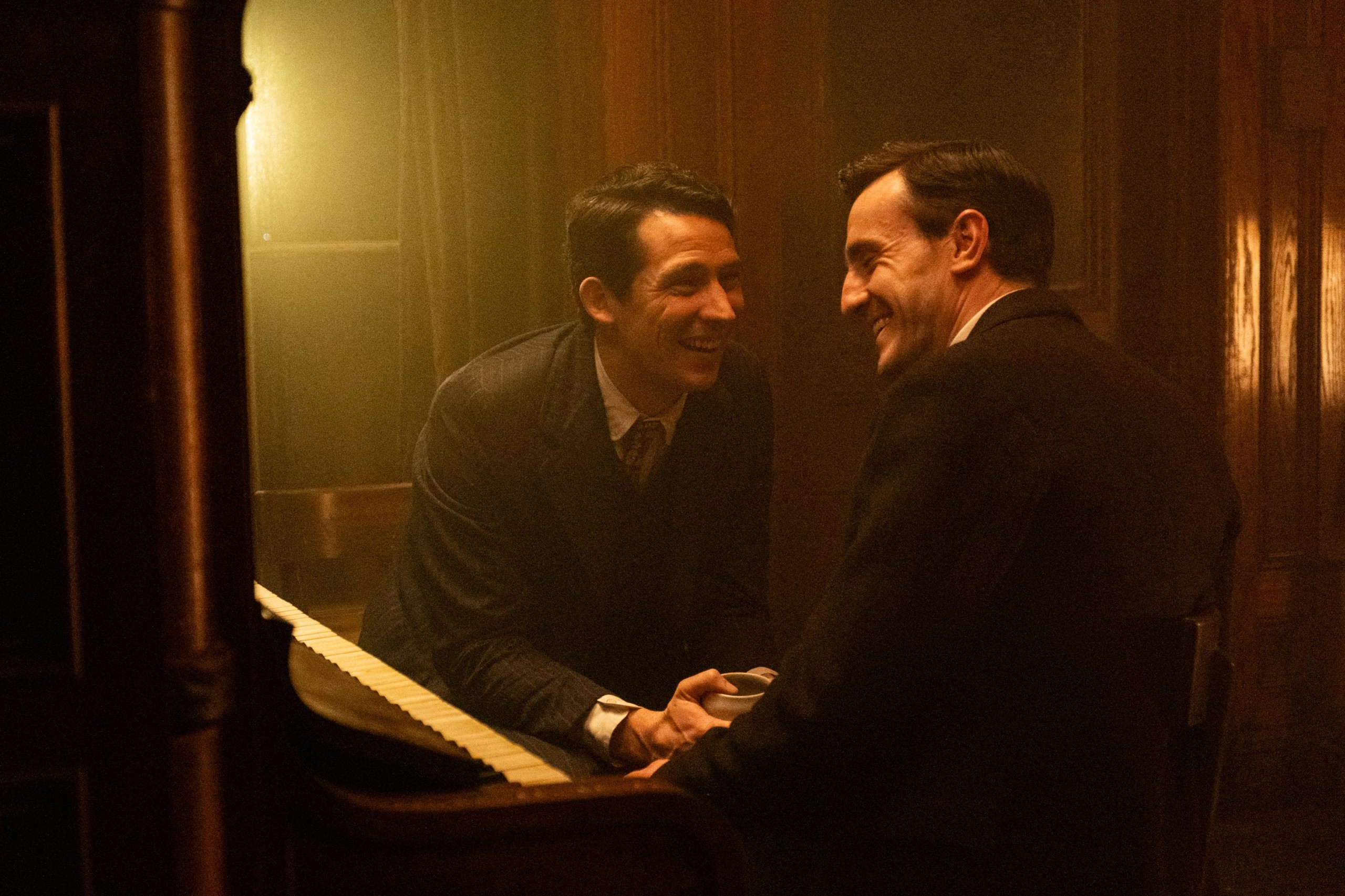

Though it holds many similarities to Ang Lee’s Brokeback Mountain, which is based on a short story by author Ben Shattuck who also wrote the screenplay, still holds it’s own as a tender gay romantic love story. This adaptation is directed by Oliver Hermanus (Living) and he directs The History of Sound with artistry and affection. He effectively uses the two plus hours to build an intimate love story that’s somewhat underwritten but is deepened with so many emotionally rich exchanges that certainly gives enough motional depth to the film.
Like, Brokeback Mountain the film takes place over the course of many years and eventually into the 1980s once the film gets to its finale. The tender love story begins in 1917, at a pub where two music students encounter each other. Lionel Worthing, a native from Kentucky encounters David White (Josh O’Connor) at pub where they bond after they find out they both share a love for folk music. The two men end up at David’s apartment and they have sex. As they spend time together, David ends up enlisting in the Army and goes off to fight in World War I. Lionel ends up returning to his home state of Kentucky. He ends up taking care of the family farm, only for his father Lionel Sr. (Raphael Sbarge) to pass away. His mother Molly gets severely depressed, allowing Lionel to feel obligated to stay home.
 Courtesy Mubi
In 1917, New England Conservatory music student Lionel Worthing meets fellow student David White at a pub, where they instantly bond over their love of folk music before returning to David’s apartment to have sex. As the two become closer, America gets involved in World War I, leading David to enlist and Lionel to return to his home state of Kentucky as the conservatory closes. He sets music aside to assist on his family’s farm after his father dies suddenly, and his mother (Molly Price) suffers through some severe depression.
Two years later in 1919, Lionel receives a letter from David that indicates that he has returned home from the war. Lionel ends up informing his mother that he will be going back up to Maine for a music project, which she attempts at throwing guilt about her health and being lonely. David and Lione’s trip consist of going on a university-funded trip where they travel along Main collecting folk songs on wax cylinders. The two reconnect and bond, and their relationship feels fleeting. Eventually, the two-part ways as David has to return to work, and Lionel travels to Europe to play with a band. The two men stay in touch with letters, only for David to stop receiving them years later.
 Courtesy Mubi
It’s an engaging love story, though a very familiar one, about the uncertainty of homosexual love in the 1920s and the detachment that comes with it. The film doesn’t quite find the conflicting tones that Ang Lee did quite well. It’s quieter and more observational, though very underwritten. The film could have benefited from a few more scenes with David and Lionel. Their chemistry doesn’t quite ignite onscreen as you would hope, but their emotions shine more when they are in separate scenes. For instance, the moment of Lionel ending another relationship with an Italian bandmate to move to London for more opportunities is a great exchange. The finest moment in the film is when Lionel visits Dave’s widowed wife, Belle (Hadley Robinson). It’s an awkward exchange at first, but both actors express so much emotional unease that it eventually finds the characters’ vulnerabilities. Especially when Lionel can’t bring himself to ask how Belle met David and that Belle has read the letters.
A gay-romantic two-hander ends up becoming more of a character study, and it also plays beautiful tribute to folk music and the power of sound, and reflecting back to the previous scenes, you tend to feel more emotionally connected to the material. That’s where older Lionel’s (Chris Cooper) scenes come in during the 1980s segments of the film. Cooper brings a lot of vulnerabilities as well to the character. He’s elderly now, and he is near to finding the closure for his love for 1980s David that he has yearned for. We see that he published a book, and he appears on broadcast television to talk about his experiences with playing music. The film’s production values are also handsome. with some poetic cinematography by Alexander Dynan that helps build the somberness of the narrative.

As we spend more time with Lionel, we feel his regrets and loneliness, and we understand just how much music and Dave meant to him. We understand that both men never got to fully live out their love for one another due to not only societal norms at the time, but due to both men being musicians and knowing how spontaneous that lifestyle can be. The emotions are genuine and involving, and even though we have seen this story before, The History of Sound is very compelling historical romantic drama.
The History of Sound is now playing in limited theaters.

This sounds interesting
Great review .it does sound interesting and I’m sure the music subject is intriguing
Loved this film . Kind of sad and melancholy. But beautifully acted, with lovely cinematography and great music
4 of 4/stars