

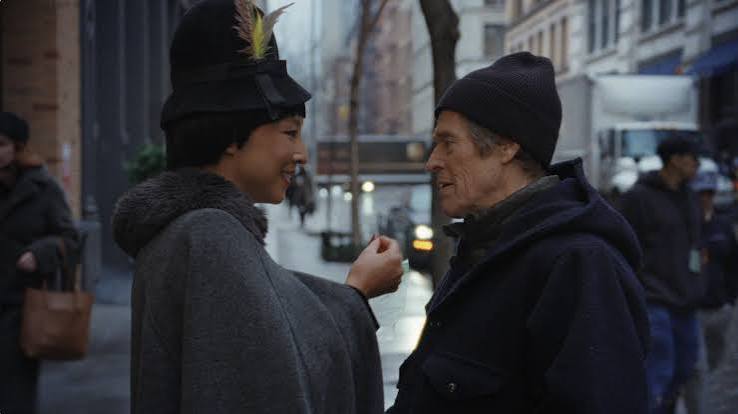

Kent Jones has made one of the most organic transitions in contemporary American cinema. Moving from esteemed film critic and scholar to co-writing Martin Scorsese’s My Voyage to Italy film essay and directing acclaimed documentaries like A Letter to Elia and Hitchcock/Truffaut, Jones proved his profound understanding of cinematic craft. With his narrative features—first Diane and now Late Fame—Jones shows that his love for cinema is matched by an empathetic curiosity about the human condition.
Written by Samy Burch (May December), Late Fame centers on a uniquely refreshing premise: the quiet afterlife of forgotten art. Willem Dafoe stars as Ed Saxberger, a long-retired poet who published a single, obscure collection back in 1979 titled Way Past Go. Ed never made it commercially and spent the subsequent decades working quietly for the New York City Post Office—a mundane, blue-collar “man of letters” routine that left his literary ambitions far behind.
Everything changes when Wilson Meyers (Edmund Donovan), an enthusiastic young writer, tracks Ed down and invites him to join a circle of twenty-something poets, playwrights, and aspiring bohemians who gather at a Soho coffee shop. Ed’s published book has long been out of print, but a few rare copies still circulate among these young devotees, who hail Ed as a lost hero of downtown Manhattan’s golden era. Intoxicated by this sudden, unexpected validation, Ed finds himself pulled back into an artistic world he thought he had abandoned.

Courtesy Magnolia
The film shines in its sharp observation of the modern art scene, particularly in a standout scene where the young group introduces Ed to an established publishing house. The publishing agent (Jake Lacy) initially appears genuinely smitten with Ed’s work, showering him with praise. However, the illusion quickly breaks when it becomes clear the agent is gung-ho about publishing a biographical memoir about Ed’s vintage era rather than actually reading or releasing his poetry. Upon learning the press primarily thrives on cookbooks and trendy non-fiction, Ed—and the audience—realize that the industry’s interest is driven by commercial fads rather than a love for the art itself.
At the heart of Ed’s journey is his relationship with Gloria (Greta Lee), the circle’s sole female member and a dedicated, uncompromising stage actress. Gloria fiercely defends her integrity, refusing to compromise her craft by auditioning for mundane, formulaic roles on network police dramas. Ed develops genuine affection and romantic feelings for her, drawn to her fierce passion and artistic conviction. Their dynamic is tender and fragile—a meeting of two idealists at vastly different stages of life, finding solace in each other’s dedication to creation.
However, the retrospective appreciation begins to feed Ed’s dormant ego. As the adulation goes to his head, Ed starts distancing himself from his reality. He begins looking down on his regular blue-collar friends and patrons at his local New York neighborhood bar, dismissively viewing them as lowbrow when they make harmless jokes about his poetry.
 Courtesy Magnolia
The film delivers a powerful narrative payoff when Ed comes to realize where true authenticity lies. While his blue-collar bar mates may lack literary pretension, their friendship is real and uncalculating. In contrast, several members of the Soho poetry club are merely using Ed’s vintage stature to boost their own visibility and credibility. The mask slips entirely in a confrontation when a young writer asks Ed to critique his work, leading to the devastating realization that the young man—like many in the group—has never actually read a single poem Ed wrote. Ed bluntly exposes the superficiality of the exchange, recognizing the transactional nature underlying their praise.
Ultimately, Late Fame concludes that while the pure act of bonding over art, poetry, and writing can be liberating, it is constantly threatened by opportunism and vanity. We feel the sting of dishonesty throughout—whether in the ambitious young writers exploiting a senior poet’s legacy or the publisher attempting to commodify a man’s life story.
By balancing this cynicism with profound warmth, Kent Jones succeeds in turning Late Fame into an insightful character study and a sharp critique of artistic integrity. Anchoring it all is Willem Dafoe, who delivers a quiet, magnificent performance that reignites his talent for tender, deeply human roles.
LATE FAME is now playing in limited theaters


Leave A Comment